Automatic vs Manual Car: Which One is Best for You?
Choosing a vehicle can be very confusing, especially when you need to decide on an automatic or manual car. The decision you make, between these two options, will impact your driving experience, convenience, fuel consumption and vehicle costs dramatically.
The difference between automatic and manual car types is quite simple: automatic cars change gears for you, while manual vehicles do so with the use of a gear stick and clutch. But how do you know which option will be best for you?
In this blog, we will compare automatic vs manual cars to help you choose the one that suits your driving style and needs.
Key Differences Between Automatic and Manual Cars
First, we need to identify the differences between auto vs manual car transmissions. Understanding what those differences are will help you decide which is right for your driving habits and budget.
| Features | Automatic Car | Manual Car |
| Gear Shifting | Automatically changes gears with speed and engine load. | The driver needs to change gears manually using the clutch and gear lever. |
| Ease of Use | Suitable for new drivers for driving in the city as it is easy to use. | Requires more experience, particularly when driving in heavy traffic or going uphill. |
| Fuel Efficiency | Less fuel-efficient on average compared to manual vehicles, although new technology is bringing improvement in this area. | These give better fuel efficiency, particularly when driving on highways and specific conditions. |
| Cost | Higher buying and maintenance costs. | Generally less costly to buy and run. |
| Driving Experience | More comfortable, more relaxed ride. | More driving experience with total control on the operations. |
| Maintenance | More advanced systems, costly to maintain. | Simpler functioning, thus more affordable to manage. |
| Resale Value | Good resale value due to growing demand for automatic cars. | Lower resale value in some markets, yet still considered for certain car types like sports vehicles. |
| Popularity | Popular in car models meant to be comfortable and easy to operate, such as sedans and SUVs. | Popular in sports cars and the entry-level car segment. |
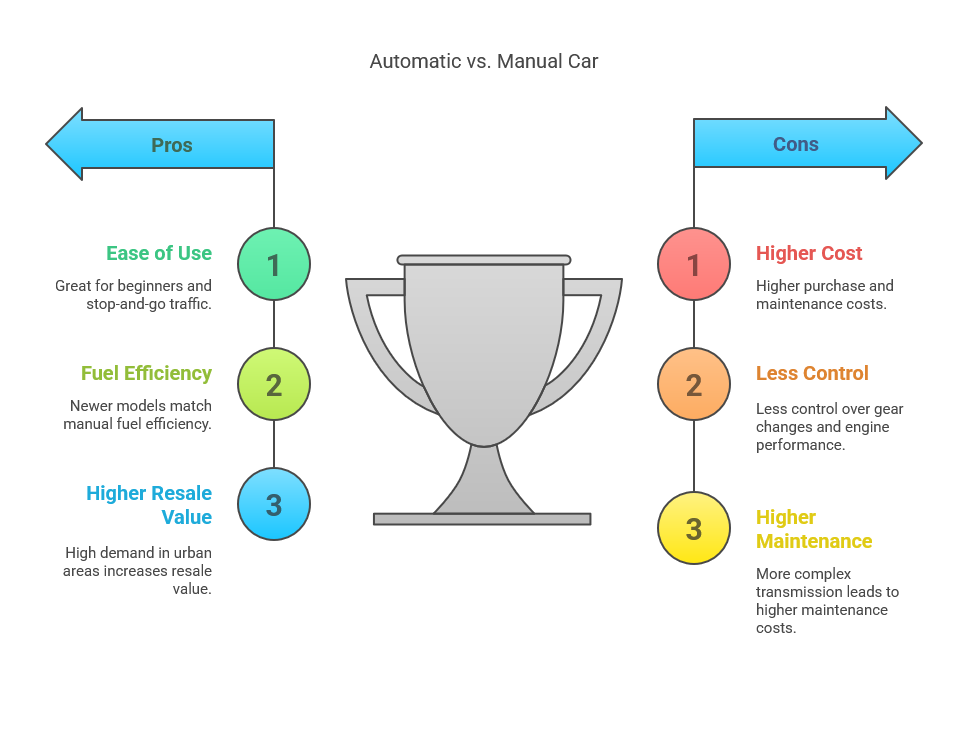
Real-Life Situations to Help You Make the Right Decision
Now that you understand the technical differences, let's see how these manifest in real-world scenarios:
- City Driving: If you drive regularly in heavy, stop-and-go traffic (in cities like Mumbai or Bangalore), an automatic car will help minimise fatigue and stress.
- Highway Driving: If you like long highway drives or need more fuel efficiency, a manual car can provide you with greater control and mileage.
- Driving Lovers: For those preferring a more engaging driving experience, manual cars provide a feeling of control that automatics simply can't achieve.
- New Drivers: Automatic cars are easier to learn and less stressful for new drivers.
- Testing: When test-driving, see how smoothly the gear shifts in automatic cars and how comfortable you feel managing the clutch and gear lever in manual cars. You can drive in city traffic and on highways to get the real result of both types of cars.
Also Read: List of Types of Electric Cars and Their Features
Which one is Easier to Drive: Automatic or Manual?
Driving a car is also a matter of convenience and comfort, particularly when you are driving through traffic. But which car is easier to drive? We compare the advantages and disadvantages of each car under different driving conditions.
| Factors | Automatic Car | Manual Car |
| Traffic Conditions | Better suited for urban driving and stop-and-go traffic since there’s no need to keep shifting gears. | More tiring in traffic because constant shifting and clutching can become tedious. |
| Learning Curve | Easier for inexperienced drivers to learn because one doesn’t have to coordinate the shifting of gears with the clutching. | Requires more practice and coordination especially for inexperienced drivers. |
| Comfort | Makes for an easier drive with less effort | Requires more effort, creating discomfort, especially in stop-go traffic |
When test-driving, pay attention to how smoothly the gear shifts happen in automatic cars and how comfortable you feel managing the clutch and gear lever in manual cars. Try driving in city traffic and on highways to get a real feel of both transmissions.
Are Automatic Cars More Fuel-Efficient Compared to Manual Cars?
One of the most crucial aspects when comparing an auto car vs a manual car is fuel efficiency. Manual cars were previously considered more fuel-efficient, but with the automatic transmission system having evolved immensely in recent decades, this isn't the case anymore.
| Features | Automatic Car | Manual Car |
| Fuel Efficiency | Older automatic cars are less efficient, but newer ones with CVT and dual-clutch technology provide better efficiency. | Generally more fuel-efficient, as the driver is able to maintain control of gear shift timing in manual vehicles. |
| Efficiency in Stop-and-Go Traffic | Automatics are slightly less efficient during stop-and-go traffic, where fuel is augmented by repeated shifting. | Manuals can maximise fuel usage in city driving by giving the driver more control of gear changes. |
| Efficiency in Highway Driving | New automatics, particularly with newer technology, are as efficient as or even more efficient than manuals on highways. | Manual cars can be more affordable on highways, as they enable better gear usage. |
As far as fuel efficiency is concerned, automatic cars have improved in recent years. They are good, if not better, than manual cars. However, if fuel efficiency is the top priority, a manual car can still offer a benefit, especially for driving on the highways.
Also Read: CNG vs Petrol vs Diesel - Which Car is the Best to Buy?
Which One is Better for City Drives: Automatic or Manual?
In heavy city traffic, the convenience of operating a car's transmission system becomes even more crucial for a smooth ride. Let's compare the two types of transmissions for city driving:
| Key Features | Automatic Car | Manual Car |
| Ease of Use | Automatic cars are easier to drive in heavy traffic as they automatically change gears. | Manual cars are tiresome in congested traffic due to constant gear changing needed. |
| Driving Comfort | Automatic cars ensure less fatigue in traffic and are the best for city driving. | Manual cars need more attention and effort, which at times makes them uncomfortable, especially during long drives. |
| Fuel Efficiency | Automatic cars are slightly less efficient in stop-and-go traffic, although they have improved their technology over the years. | Manual cars have better fuel efficiency in city driving as there is better control over gear changes. |
If you're driving in a city, typically through stop-and-go traffic, an automatic vehicle is likely better for you since it's less tiring to drive and will tire you out less. But if fuel efficiency is the number-one priority for you and you prefer more control over the car, then you can opt for a manual vehicle.
Automatic vs Manual: Which Transmission is Suitable for Beginners?
For new drivers or first-time car buyers, whether to choose an automatic car or a manual car is a crucial decision to make. The two are compared thus as a choice for beginners:
| Factors | Automatic Car | Manual Car |
| Ease of Learning | An automatic car is easier to learn and drive as there is no need to manually change gears. | Manual cars may take longer to learn as the driver needs to learn how to use the clutch and change gears. |
| Driving Comfort | More easier for new drivers and the focus is on steering and not on changing gears. | Requires time and patience for the new driver to understand the system and become confident. |
For the majority of first-time drivers, an automatic car might be the better option. An automatic car is simpler to learn, particularly for new drivers. However, if you prefer a more hands-on driving experience and don't mind working a bit harder at it, then the manual car might be a good choice for you.
Also Read: What is the Importance of Mileage for Used Cars?
Are Automatic Cars Costlier Than Manual Cars?
Cost is always a crucial factor when buying any car. When comparing an automatic with a manual car, the automatic car will often cost more. Let's break down the cost differences:
| Features | Automatic Car | Manual Car |
| Upfront Cost | Automatic cars generally may cost more because the transmission system is more complex. | Manual cars will cost less upfront, as well as in the long-term maintenance costs. |
| Maintenance Costs | There will be higher repair costs for automatic cars, especially if the issue is with the transmission. | Manual cars can be less expensive to maintain due to simple mechanisms and fewer parts that need replacement. |
| Insurance Premium | The insurance premiums can be more for automatic cars because of the higher price tag and higher level of complexity. | Premiums for manual cars are usually lower as they are considered less complicated and are priced lower than the automatic ones. |
In short, automatic cars are more expensive to buy and maintain. But they could provide more convenience for you, especially if you plan to keep your vehicle for many years and won't mind paying the extra costs.
Alternatively, you can consider buying a certified second-hand car. The best part is that many loan providers nowadays offer Used Car Loans to help finance your purchase.
How a Used Car Loan Can Help You Buy Your Favourite Car?
Once you choose between an automatic and a manual car, you can finance up to 90% of its cost with a loan for used cars. Whether salaried or self-employed, you can easily apply for a Used Car Loan online. At Hero FinCorp, you can get up to Rs 50 Lakh with attractive interest rates and flexible repayment tenures of up to 5 years.
Conclusion
Your choice between an automatic and manual car should be based on your daily driving needs, comfort level and budget. Automatic cars are suitable for city commuters and new drivers, while manual cars provide better control and efficiency for highway and enthusiast drivers. Test drive both and consider your specific requirements before making a decision.
Also Read: What is Second Hand Car Zero Down Payment?
Frequently Asked Questions
1. What is the difference between automatic and manual cars?
Automatic cars can shift without the need for the driver to intervene, while manual cars require the driver to manually shift the gears.
2. Which car is easier to drive: automatic or manual?
Automatic cars are easier to drive, especially in heavy traffic. They eliminate the need for shifting of gears.
3. Are automatic cars more fuel-efficient than manual ones?
Automatic cars have recently become more efficient; however, manuals still often outperform them in certain driving conditions.
4. Do automatic cars cost more than manual cars?
Automatic cars often have a higher purchase and maintenance cost in comparison to manuals; however, an automatic car provides convenience.
5. Which is better for city driving: automatic or manual?
Automatic cars tend to be better for city driving, considering their ease of use in stop-and-go traffic.
6. Are automatic cars better for beginners?
Yes, automatic cars are easier for a beginner to learn to drive as they do not require any shifting of gears or control of the clutch.
Disclaimer: The information provided in this blog post is intended for informational purposes only. The content is based on research and opinions available at the time of writing. While we strive to ensure accuracy, we do not claim to be exhaustive or definitive. Readers are advised to independently verify any details mentioned here, such as specifications, features, and availability, before making any decisions. Hero FinCorp does not take responsibility for any discrepancies, inaccuracies, or changes that may occur after the publication of this blog.