Capital Structure: Meaning, Types, Importance, and Examples
Each and every business or company requires money to smoothly function, expand its operations, and remain stable in terms of finances. The companies arrange the funds through different ways, like selling shares (equity), borrowing loans or using a mix of both. This is called a company’s capital structure. defines the cost of capital for the company, affects its profitability, and indicates its level of financial risk (e.g., greater debt levels raise the risk of bankruptcy).
Understanding the types, importance, and meaning of capital structure helps a company make well-informed decisions related to financial planning, performance, and when comparing itself with other companies. Capital structure is a significant aspect of money handling and planning for businesses of all sizes. It enables a company to obtain loans and remain healthy for many years—not only make profits.
What is Capital Structure?
Capital structure refers to the way a business utilises a combination of borrowed capital (loans) and its own money (equity) in order to operate its day-to-day operations, expand operations, and remain healthy financially. It is like a blueprint that guides the business in making informed choices regarding the amount of money to be borrowed and the amount to utilise from its own funds.
How Does a Capital Structure Work?
The capital structure of a company illustrates how it arranges money to operate its business and settle its bills. It also facilitates decisions regarding investment, risk, and profit. Opting for an appropriate proportion of loans and its own capital can reduce expenses and make the business strong in the long term.
Here’s an example:
If a firm uses 60% of its own money and 40% of its loan, it minimises repayment pressure while retaining control and ensuring steady growth.
Different Types of Capital Structures
A company can have different types of capital structures depending on how they arrange their financing. Each capital structure can have distinctions in ownership, financial risk and cost of raising capital.
Equity Capital
Equity capital is the money a company raises from shareholders or owners. The funds do not have to be repaid, but ownership dilution will occur with shared ownership. Primarily, equity capital is used for long-term expansion of the business.
Debt Capital
Debt capital generally consists of money borrowed from outside sources in the form of loans or bonds, and the funds must be repaid with interest within an agreed timeframe. Debt capital has more tax benefits than equity capital, and while borrowing to fund growth can generate shareholder value, too much borrowing of loans can lead to financial distress.
Hybrid Capital
Hybrid capital, as the title suggests, has the elements of both loans as well as equity. Preference shares (fixed dividends like debt, no voting rights like equity) and convertible debentures (debt convertible to equity) are examples of hybrid capital. Hybrid capital gives more flexibility and usually it's used by larger companies for tax efficiency..
Optimal Capital Structure
An optimal capital structure balances debt and equity to minimise funding costs while aligning with the company's risk profile and growth needs. When structured effectively, it enhances returns and financial performance by ensuring borrowed capital generates higher returns than its cost.
Also Read: What Does Capital Mean In Business?
Capital Structure Formula
To best understand the company's money from loans compared to the total money, you should have an understanding of the capital structure formula. It provides a quick view of how the company generates its funds. Here is the formula:
Capital Structure = (Total Debt ÷ Total Capital) × 100
This formula will help figure out the portion of loans in total capital. This will give the company an idea of the loan funds that are being utilised.
Capital Structure Example
In order to understand how capital structure is determined, let us understand through an example of a real-life business situation.
Example:
Suppose a company has taken a loan of Rs 50 Lakh and it has Rs 50 Lakh own money (equity). Here, the capital structure is 50:50, meaning the company is using an equal amount of borrowed money and own funds to finance its operations.
Also Read: What Are Different Types of Working Capital?
Importance of Capital Structure
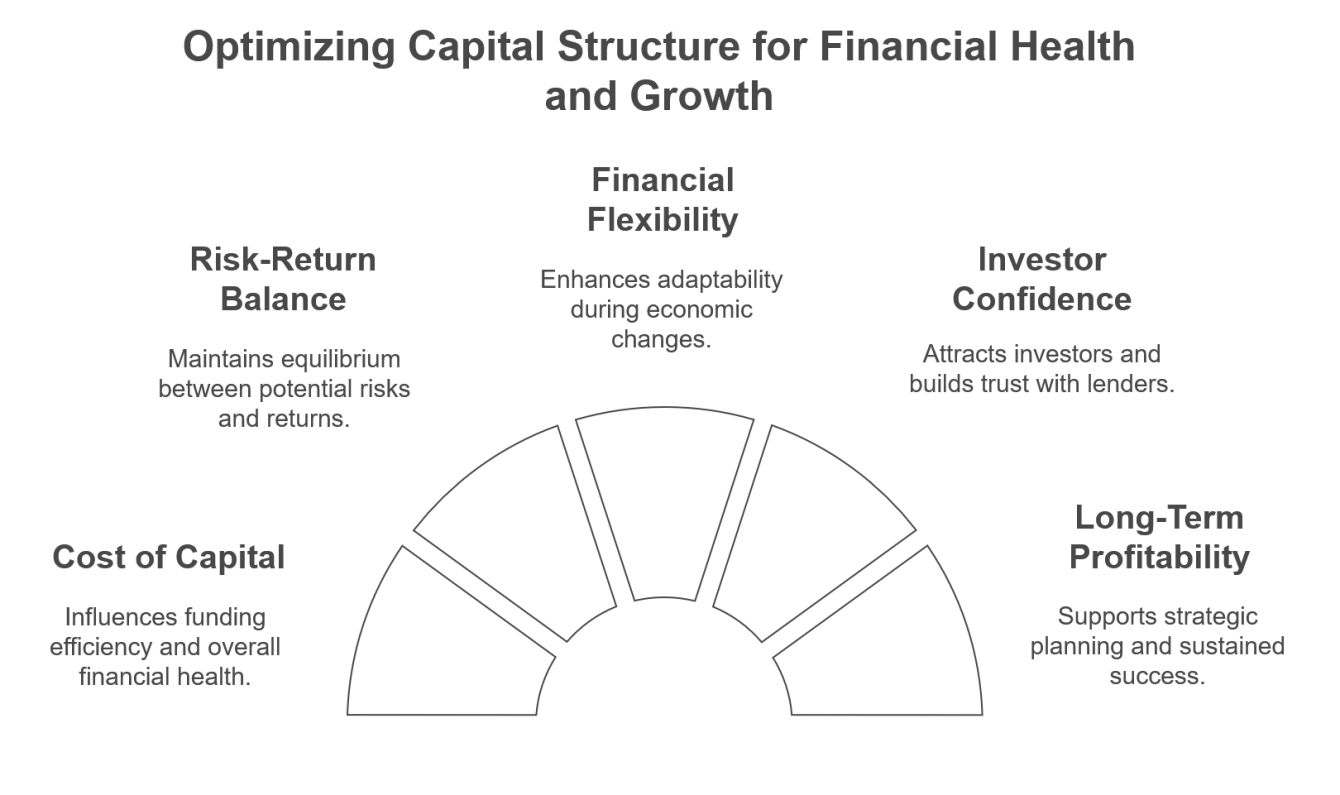
A well-planned capital structure of a business is important for its financial well-being. It affects how a company expands, acquires funds, and handles risks, as well as how investors perceive the business and long-term sustainability.
- Determines the total cost of funds and how effectively they are utilised
- Balances risk with the possibility of returns
- Boosts financial flexibility during expansion or downturns
- Facilitates the attention of investors and earns lenders' confidence
- Affects control and shareholding distribution
- Plays a role in consistent dividend policies
- Enhances the reputation of the company in the market
- Facilitates long-term profitability and planning for the future
Factors That Determine Capital Structure
A variety of inside and outside factors influence how a business decides its capital structure. These factors affect the risks a business will take, how it will arrange funds, and what its long-term financial goals will be.
- Business stability and risk: Companies with stable incomes can handle more loans easily.
- Availability of funding sources: Access to equity or loans helps shape the capital structure.
- Market conditions and interest rates: The current market status affects borrowing costs and other terms.
- Tax considerations: : Interest payable on loans is tax-deductible, affecting capital choice.
- Management control preferences: Ownership gets diluted by equity; loans retain control.
- Growth and expansion plans: Ambitious growth plans need flexible funding sources.
- Regulatory environment: Rules may limit debt levels or influence the structure.
- Company size and profitability: Large, profitable companies tend to have access to a range of funding.
Also Read: Cost of Capital: Types, Importance, Formula, and Example
The Importance of Managing Capital Structure for Business Loan Approval
Planning to build a strong capital structure is important for companies looking for loans, as it directly affects lenders’ trust and eligibility for the loan.
- Shows that the business can handle money responsibly and is less risky
- Proves that the company can repay loans, making loan providers more confident
- Helps maintain a good balance between debt and equity, showing smart money planning
- Helps the business get bigger loan amounts with favourable conditions
- Makes loan approval faster because the company’s financial records are clear and well-organised
How to Apply for a Business Loan?
Applying for a Business Loan has never been easier or faster. Just head to the Business Loan page of the Hero FinCorp website and click on the Apply Now tab. Fill in basic details and upload the required documents. You can avail of up to Rs 40 Lakh with attractive rates of interest and a repayment period of up to 5 years.
Conclusion
To make your company's financial base stronger, begin by reviewing the current capital structure. Ensure the correct proportion of debt and equity that would help in expansion while minimising risk. Review your funding plan from time to time to synchronise it with business objectives. A well-managed structure not only instills confidence among investors but also improves your approval chances when you apply for a Business Loan.
Also Read: What is Capital Loss? Example, Formula and Advantages
Frequently Asked Questions
1. What are the four factors of capital structure?
The main factors include business risk, tax rate, financial flexibility, and control considerations.
2. What are the four theories of capital structure?
Theories include the Modigliani-Miller Theory, Trade-Off Theory, Pecking Order Theory, and Agency Theory.
3. Who proposed the capital structure theory?
The foundational theory was proposed by Franco Modigliani and Merton Miller in 1958.
4. What is a capital theory?
Capital theory deals with how capital is accumulated, allocated, and used for production over time.
5. What is capital structure management finance?
It involves strategically planning and adjusting the mix of debt and equity to support a company’s long-term goals.
Disclaimer: The information provided in this blog post is intended for informational purposes only. The content is based on research and opinions available at the time of writing. While we strive to ensure accuracy, we do not claim to be exhaustive or definitive. Readers are advised to independently verify any details mentioned here, such as specifications, features, and availability, before making any decisions. Hero FinCorp does not take responsibility for any discrepancies, inaccuracies, or changes that may occur after the publication of this blog. The choice to rely on the information presented herein is at the reader's discretion, and we recommend consulting official sources and experts for the most up-to-date and accurate information about the featured products.